Catnip is one of the most famous pet treats in the world — and one of the most misunderstood. Why does a tiny pinch turn some cats into rolling, purring acrobats while others completely ignore it? This guide walks you through what catnip really is, the science behind the reaction, and how to use it safely with your cat.
What is catnip, really?
Catnip (Nepeta cataria) is a perennial herb in the mint family. It grows as a leafy green plant with small white-and-purple flowers, native to parts of Europe and Asia and now widespread across North America. The plant contains a natural compound called nepetalactone — and that compound is the reason your cat may transform into a flopping, rolling, purring fool the moment a fresh sprinkle hits the floor.
Catnip is not a drug, not addictive in the human sense, and not harmful when offered in normal amounts. It’s simply a plant whose chemistry happens to interact with the receptors in some cats’ noses in an unusual way.
Why cats react to catnip
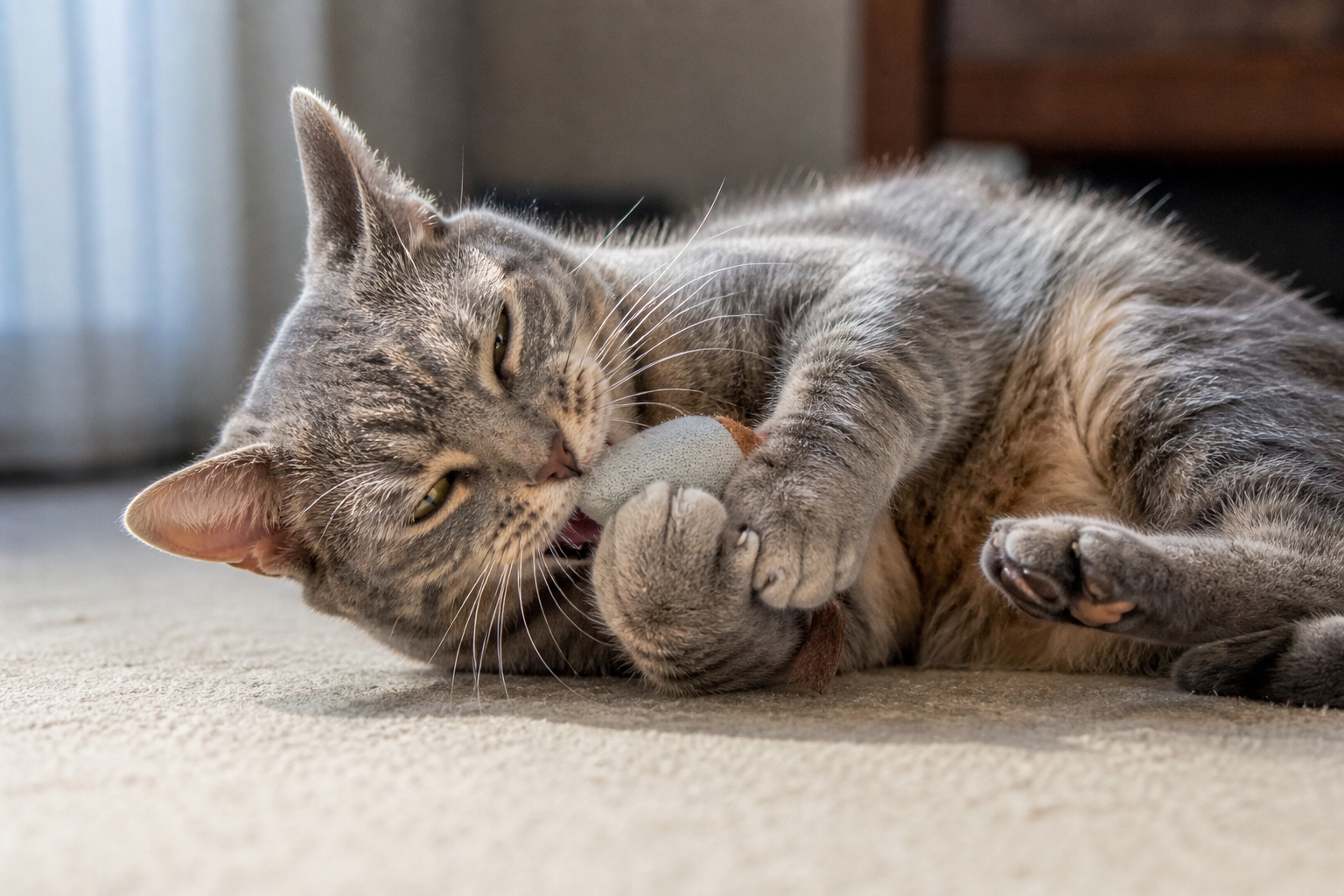
When a cat sniffs catnip, the nepetalactone binds to receptors in their nasal tissue. This triggers signals in the brain regions that handle behaviour, mood, and “happy” responses. The reaction usually lasts about 10–15 minutes and may include:
- Rolling, rubbing, and stretching
- Vocalising or trilling
- Bursts of zoomies
- Mellow, drowsy lounging once the energy fades
Cats can also react to catnip when they eat it, but the response is usually gentler — more “calm” than “wild.” The classic theatrical reaction is the smell-based one.
After about 10 minutes, most cats lose interest and become “immune” for roughly 30 minutes to two hours. This refractory period is normal, and it’s why a constant supply doesn’t keep them euphoric.
Why some cats don’t react at all
It’s a common myth that “every cat loves catnip.” In reality, somewhere between 30% and 50% of cats show no reaction at all. Sensitivity to catnip is genetic, and cats either inherit it or they don’t. There’s nothing wrong with a cat who shrugs at catnip — they just didn’t get the gene.
A few other groups also tend to react less:
- Kittens under about 3–6 months
- Older or unwell cats
- Cats with a stuffy nose that day
If your cat seems unimpressed, don’t take it personally. There are alternatives that work for many “catnip-resistant” cats — more on those below.
Forms of catnip and how to use them
Catnip comes in several formats, and each has its place:
Dried catnip leaves
The classic format. A pinch on a scratcher, in a toy, or sprinkled on a cardboard pad usually does the job. Store dried catnip in an airtight container away from light to keep it potent. Older catnip loses its punch.
Catnip-stuffed toys
A great option if you want a no-mess way to deliver the experience. Look for toys with refillable pouches so you can top up the catnip when the toy fades.
Catnip spray
Excellent for refreshing existing toys, scratchers, or carriers. A light mist on a cat tree can also re-spark interest in furniture they’d been ignoring. Spray works well — but loses scent faster than dried leaves.
Live catnip plants
If you have outdoor space, a small catnip plant can be a wonderful enrichment source. Indoors, the plant tends to get over-loved (read: chewed flat) within a few days.
Safe use: how often, how much, and when
Catnip is generally considered safe for healthy adult cats. A few practical guidelines:
- A pinch is plenty. A teaspoon of dried catnip is more than enough for most cats per session.
- Limit to 1–2 sessions per week. If your cat has access to catnip every day, the effect can fade temporarily.
- Don’t force it. Some cats prefer to dictate their own catnip schedule. That’s fine.
- Watch for tummy upset. Eating large amounts of fresh leaves can cause mild vomiting or diarrhoea. Stick to small portions.
If your cat has a chronic health condition, is pregnant, or you’re not sure about anything related to their wellbeing, please ask your veterinarian before introducing catnip. We’re a pet shop, not a clinic — your vet knows your cat best.
Alternatives if catnip falls flat
If your cat doesn’t respond to catnip, try these:
- Silvervine (Actinidia polygama) — works on a higher percentage of cats than catnip does. Often described as a popular catnip alternative used by Japanese pet owners. Sold as sticks, powder, or in stuffed toys.
- Valerian root — produces a similar play-and-roll response in many cats. Has a strong smell that humans tend to dislike, but cats love it.
- Tatarian honeysuckle wood — small chunks of this wood release a scent some cats find irresistible.
A multi-herb blend is sold in many cat toys for exactly this reason: it covers more cats.
Practical tips for cat owners
- First-time intro: Sprinkle a tiny amount on the floor and watch from a distance. Don’t pet your cat during the reaction — most cats prefer to “process” catnip alone.
- Refresh old toys with a quick spritz of catnip spray instead of buying new ones constantly.
- Use catnip strategically: before nail trims (to relax them), to encourage a new scratcher, or to make a new bed feel like home.
- Storage matters: Keep dried catnip and catnip toys in airtight containers between uses so the scent doesn’t fade.
Browse our Cats collection for catnip toys, scratchers with built-in catnip pockets, and cat-safe enrichment essentials — or read more in our Cats guides.
Frequently Asked Questions
Is catnip safe for kittens?
Most kittens don’t respond to catnip until 3–6 months old. Once they do, small amounts are generally fine for healthy kittens. If you have any concerns, ask your vet.
Can my cat overdose on catnip?
A true overdose is extremely rare with normal amounts. Eating very large quantities of fresh catnip leaves can cause mild stomach upset, but cats almost always self-regulate.
My cat ignores catnip — is something wrong?
No. About a third to half of all cats simply don’t have the catnip-sensitivity gene. It’s perfectly normal. Try silvervine or valerian instead.
How long does the catnip “high” last?
Usually 10–15 minutes, followed by a 30-minute to 2-hour cooldown where your cat won’t respond again.
Where should I store catnip?
In an airtight container, away from light and heat. Some cat owners freeze dried catnip to keep it fresh for months.











 Food & Nutrition
 Treats & Chews
 Toys
 Beds & Furniture
 Bowls, Feeders & Hydration
 Collars, Leashes & Harnesses
 Crates, Carriers & Travel
 Apparel & Accessories
 Grooming
 Health & Wellness
 Training & Behavior

 Food & Treats
 Litter & Cleanup
 Toys
 Trees & Scratchers
 Beds & Furniture
 Bowls & Feeders
 Health & Wellness
 Collars, Harnesses & Apparel
 Carriers & Travel