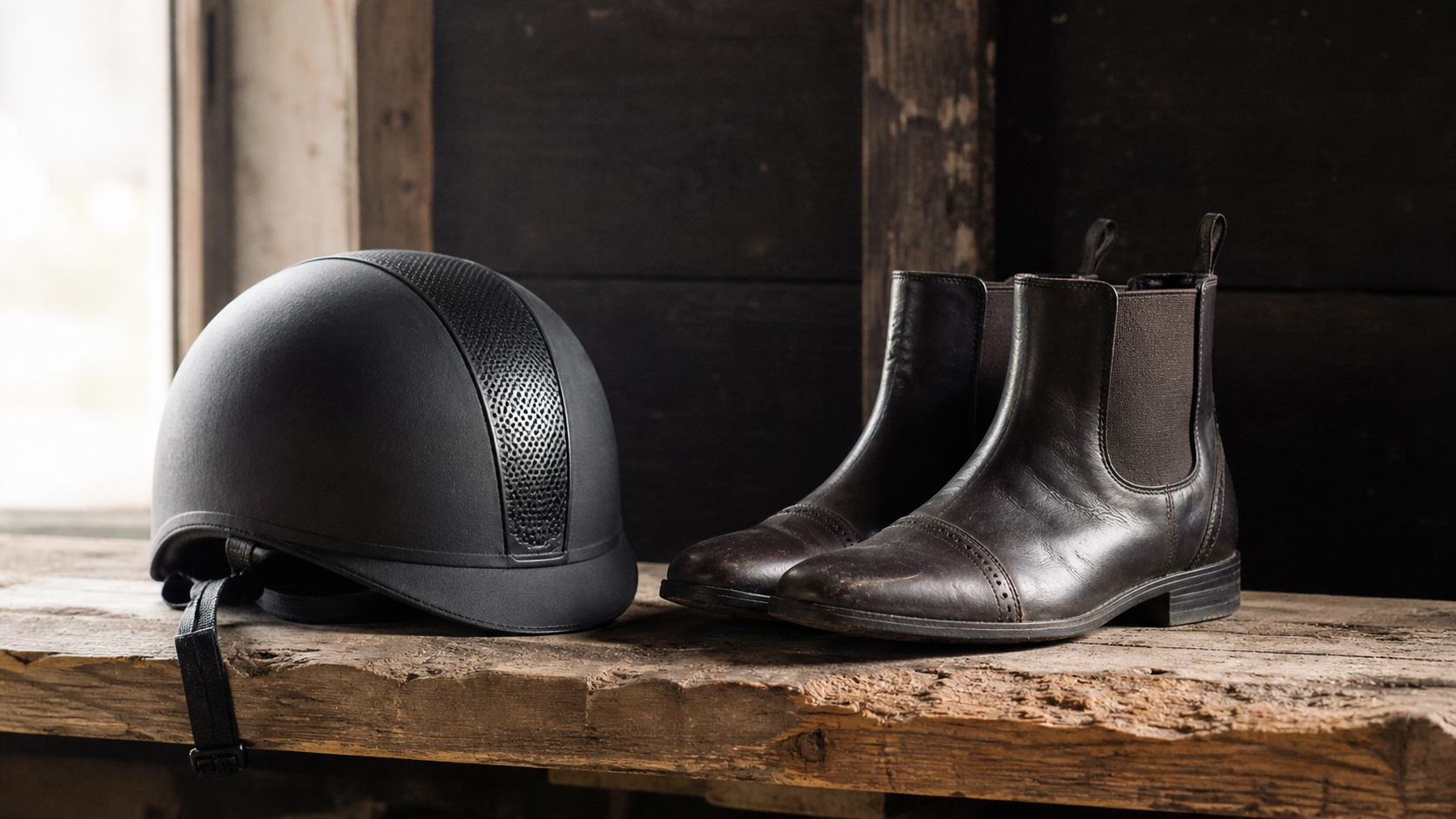
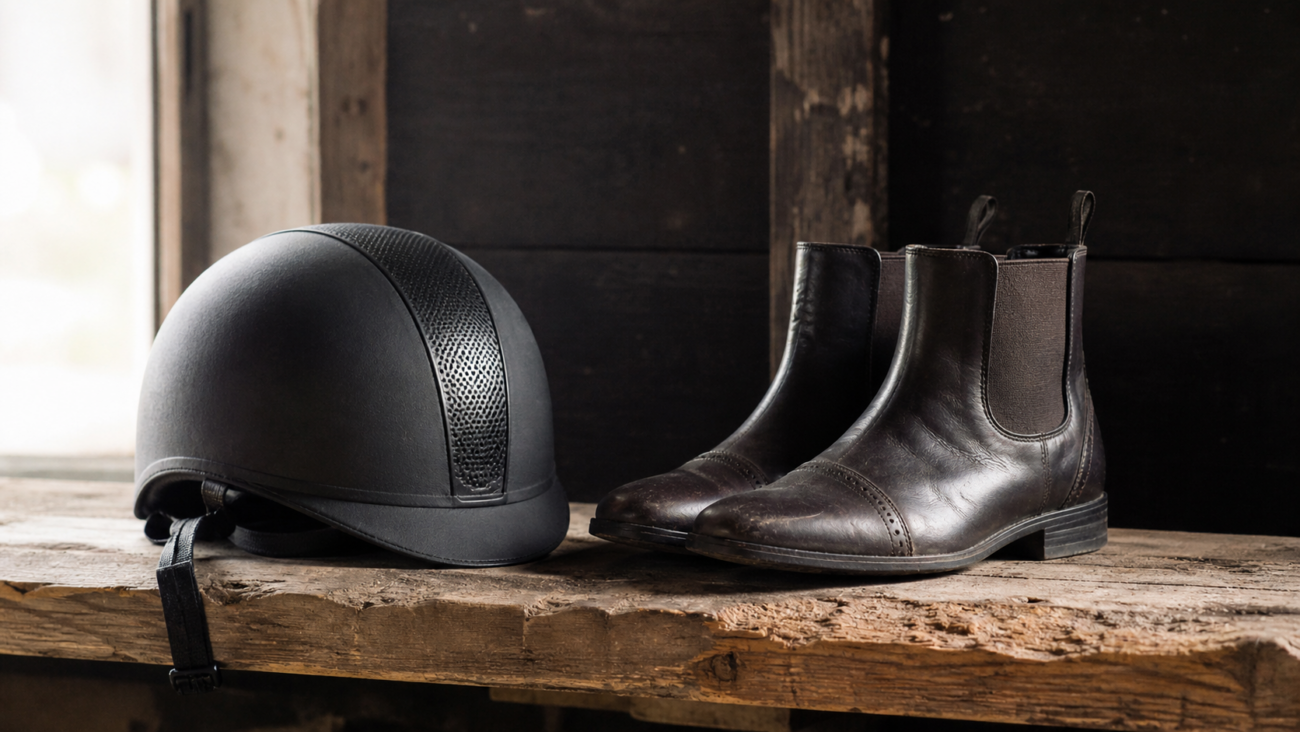
If you spend money on only two pieces of equestrian gear before anything else, make them a certified riding helmet and a pair of properly fitted boots. These two items protect you in real, measurable ways. Saddles, blankets, and pretty browbands can wait — head and feet cannot.
This guide walks you through certifications, fit, when to replace, and how to make a smart choice as a beginner.
Why a certified helmet matters
A riding helmet is not the same as a bike helmet, a motorcycle helmet, or a construction hard hat. Equestrian helmets are designed for the specific impacts most likely in horse sports — falls from height onto firm ground, often with a horse nearby.
An uncertified helmet is no real protection. Always look for the certification sticker before buying.
ASTM/SEI certification — what it means
In the U.S., the standard to look for is ASTM F1163 / SEI certification. ASTM sets the testing standard, and SEI verifies the helmet was tested by an independent lab. Both stickers should be inside the helmet.
Helmet certifications also apply outside the U.S. (look for VG1, PAS 015, EN 1384, or Snell E2021). For U.S. riders, ASTM/SEI is the baseline.
Note: certifications confirm a helmet meets impact standards. They do not guarantee protection in any specific accident. Always ride with care.
Helmet fit — the two-finger test
Even a certified helmet does not protect a head it does not fit. Test fit with your hair as you usually wear it, then:
- Place helmet level — front edge two fingers above eyebrows
- Side straps form a V under each ear
- Chinstrap snug — should fit one finger between strap and chin
- Shake your head — helmet should not slide front-back or side-to-side
- Press up on front rim — helmet should resist tipping back
If a helmet shifts on a head shake, it is too big.
When to replace your helmet
Replace a riding helmet:
- After ANY fall, even if the helmet looks fine — internal foam compresses on impact
- Every 5 years (foam degrades over time)
- If it is damaged, dropped on a hard surface, or stored in extreme heat (cars, attics)
Manufacturers may have specific guidance — read your helmet’s instructions. When in doubt, replace.
Boot types — paddock, tall, western
Riding boots have a heel for safety (prevents foot from sliding through the stirrup) and a smooth sole that releases easily.
- Paddock boots — short, ankle-height. Good for daily barn use and lessons. Pair with half-chaps for riding support.
- Tall boots — knee-height. Used in English disciplines for shows and serious training.
- Western boots — typically taller, with a higher heel and pointed toe for western disciplines.
Beginners are usually best served by paddock boots with half-chaps — comfortable, affordable, and versatile.
Heel and sole — what’s safe
Look for:
- A defined heel (about ½–1 inch) to prevent foot from going through stirrup
- A smooth, low-tread sole — deeply lugged hiking soles can catch in stirrups
- Snug-but-not-painful fit — riding-specific lasts are typically slimmer than fashion boots
Sneakers, work boots, and rain boots without proper heels are unsafe to ride in.
Fitting kid riders
Kids grow fast, but never compromise on certification or fit. A too-big helmet shifts. A too-big boot can slip through a stirrup. Buy what fits today, replace as the child grows. Pre-loved gear is fine — but inspect helmets carefully and replace any helmet involved in a fall.
Care that extends life
- Wipe helmet liner gently with mild soap and water; air dry
- Store helmet out of direct sun, away from heat and chemicals
- Never leave helmets in a hot car
- Clean leather boots after barn use and condition monthly
- Air boots fully — damp boots breed mold and rot stitching
A safety-first checklist
- ✅ ASTM/SEI certified helmet that fits with the two-finger test
- ✅ Chinstrap fastened every ride (yes, even hand-walking)
- ✅ Boots with proper heel and smooth sole
- ✅ No worn-out or post-fall helmets in use
- ✅ Helmet replaced every 5 years
- ✅ Riding gloves if your hands blister easily
- ✅ Body protector (vest) if jumping or eventing
FAQ
Can I use a bike helmet for riding?
No. Bike helmets are designed for different impacts and do not meet equestrian safety standards. Always use an ASTM/SEI-certified riding helmet.
How much should I spend on a riding helmet?
Quality certified helmets start around mid-priced; high-end models offer better ventilation, fit options, and aesthetics. Spend within your budget — a properly fitted entry-level certified helmet is far better than no helmet.
How do I know if my boots are safe to ride in?
Check three things: a defined heel (½–1 inch), a smooth sole that slides easily out of the stirrup, and a snug fit. If your foot can slip forward through the stirrup, change boots.
Should I replace my helmet after a small fall?
Yes. Even a fall without visible damage can compress the protective foam invisibly. Helmets are designed to absorb one significant impact and then be replaced. Always.
Are body protector vests worth it?
For jumping, eventing, or any riding involving speed and obstacles — yes. For flat work and trail riding, opinion varies. Discuss with your trainer based on your riding goals.
The takeaway
The two pieces of equestrian gear that matter most are a certified, properly fitted helmet and safe riding boots. Replace your helmet after any fall and every 5 years. Browse our Equestrian & Ranch shop for safety gear, or explore more horse guides on the Petrending blog.






 Food & Nutrition
 Treats & Chews
 Toys
 Beds & Furniture
 Bowls, Feeders & Hydration
 Collars, Leashes & Harnesses
 Crates, Carriers & Travel
 Apparel & Accessories
 Grooming
 Health & Wellness
 Training & Behavior

 Food & Treats
 Litter & Cleanup
 Toys
 Trees & Scratchers
 Beds & Furniture
 Bowls & Feeders
 Health & Wellness
 Collars, Harnesses & Apparel
 Carriers & Travel